Rotation Program: Cohort Learning Journey
Every rotation has a story, but without the right structure most of it fades before anyone hears it. I designed this program so participants wouldn’t just complete a rotation, they’d make meaning of it, build relationships along the way, and come home with a story worth telling. This project shows how I built that experience end to end, from the first conversation to the final presentation.
Disclaimer: Work produced with my previous employment is considered Confidential, Proprietary, and/or Need-to-Know. This sample includes descriptions created to show my design process.
Learning Modalities: ILT, VILT, Facilitator-Free Social Learning
Tools: Keynote, Generative AI
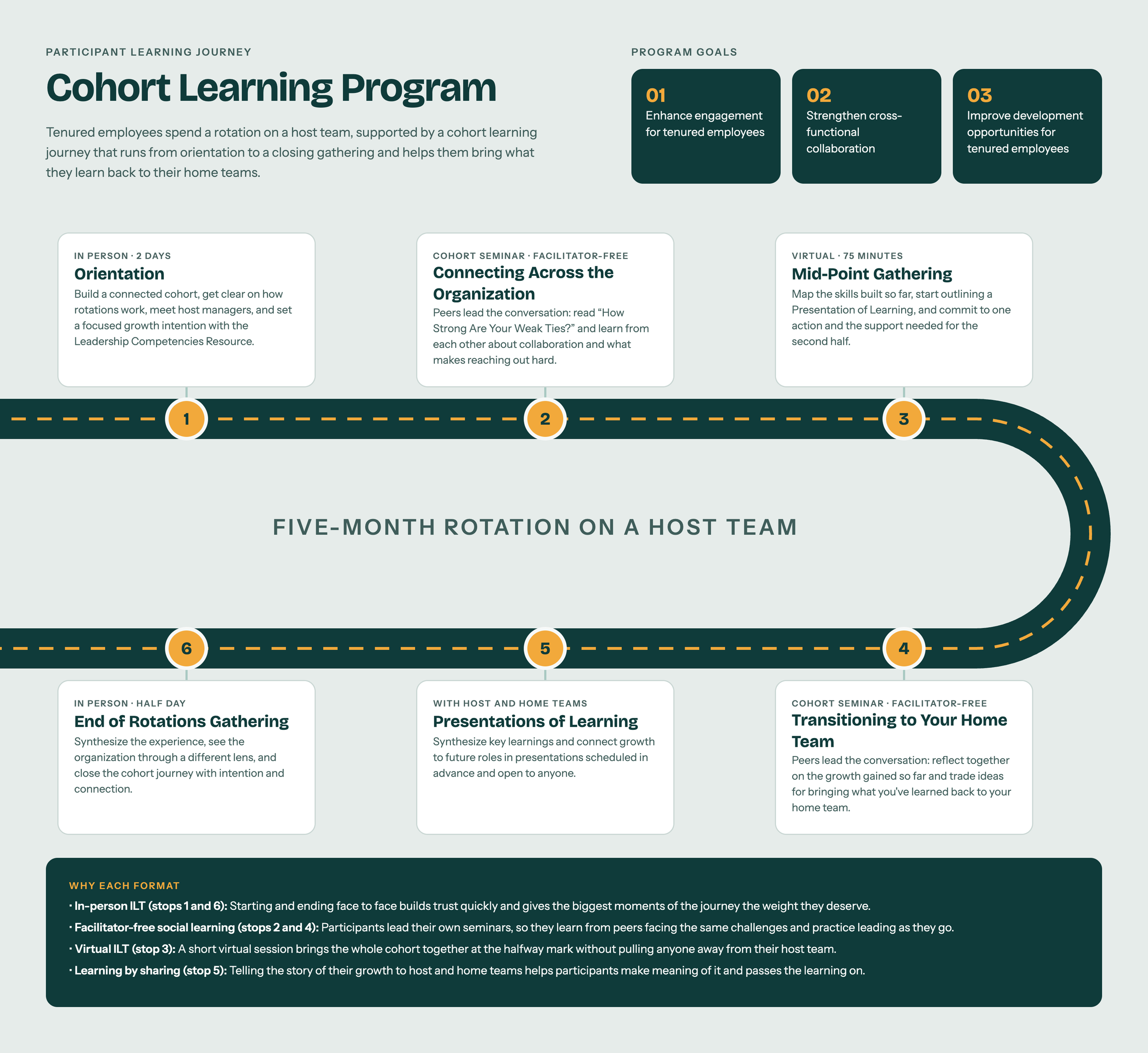
Summary: The Cohort Learning Program is a five-month rotations program for tenured employees. Each participant joins a host team while a cohort learning journey helps them connect, reflect and bring their learning home: an in-person orientation, peer-led cohort seminars, a virtual mid-point gathering, presentations of learning and a closing gathering. I created all of the content that supported the program, using community building and skill development to make the experience meaningful and memorable.
Challenge: Tenured employees bring deep expertise, but their engagement and growth can stall when their work stays inside one team. A rotation offers a new context, yet the experience alone doesn't guarantee learning sticks: research on rotations shows people often return with valuable knowledge and struggle to transfer it. Participants needed structure to make sense of the experience, build connections across the organization, and bring what they learned back to their home teams.
Solution: A cohort journey held together by one metaphor: each participant is a thread. At orientation the cohort weaves a tapestry from their stories; the seminars strengthen weak ties across the organization; participants return as bridges between two teams; and the closing "Connective Threads" activity ties every thread together. The design draws on learning science:
Storytelling and metaphor: the thread metaphor gives the five months one through-line, and the Presentation of Learning is framed as the story of how you grew, not a report.
Social learning: facilitator-free cohort seminars are led by participants, who take turns as facilitator and note-taker and share "aha moments" with the cohort.
Reflection and memory anchors: a recorded "Rotations Spotlight" interview captures each participant at the start, because much of an experience fades within a year without an anchor.
Spaced learning: monthly touch-points revisit and build on ideas across the whole rotation.
Transfer of learning: host and home managers join key moments, from a Rotations Roadmap at the start to capability mapping and a 30-day check-in at the end.
Design process: The workshop was built using ADDIE.
Analysis: Three program goals guided the work: enhance engagement, strengthen cross-functional collaboration and improve development for tenured employees. Research on rotations pointed to the re-entry gap as the biggest risk to learning transfer.
Design: A five-month journey with in-person bookends, peer-led seminars and a virtual mid-point, tied together by the thread and tapestry metaphor.
Development: I created all of the program content: session decks with facilitator notes, activities, participant notebooks and handouts, the Rotations Roadmap, and seminar materials that participants facilitate themselves.
Implementation: The pilot was run with participants in two cities, who came together for orientation and closing, met virtually at the mid-point, and led their own monthly seminars.
Evaluation: An end-of-program survey, presentations of learning, shared aha moments and 30-day manager check-ins will show what participants learned and carried back.
Expected results: Participants will return re-engaged, with broader networks across the organization and a clear story of how they grew. Managers on both sides will know what the participant contributed and how to put new capabilities to work, so the home team benefits from the rotation too. The thread metaphor and the participant-led seminar model also give the organization a repeatable, scalable way to run future cohorts.