Launch a Local AI Community
What started as a way to help my own team keep pace with AI became a repeatable model for learning it together. This project shows how I designed the community from the ground up, and how I turned it into a playbook that teams at other companies can use to launch their own.
Disclaimer: Work produced with my previous employment is considered Confidential, Proprietary, and/or Need-to-Know. This sample includes descriptions created to show my design process.
Learning Modality: Job aid
Tools: Keynote, Generative AI
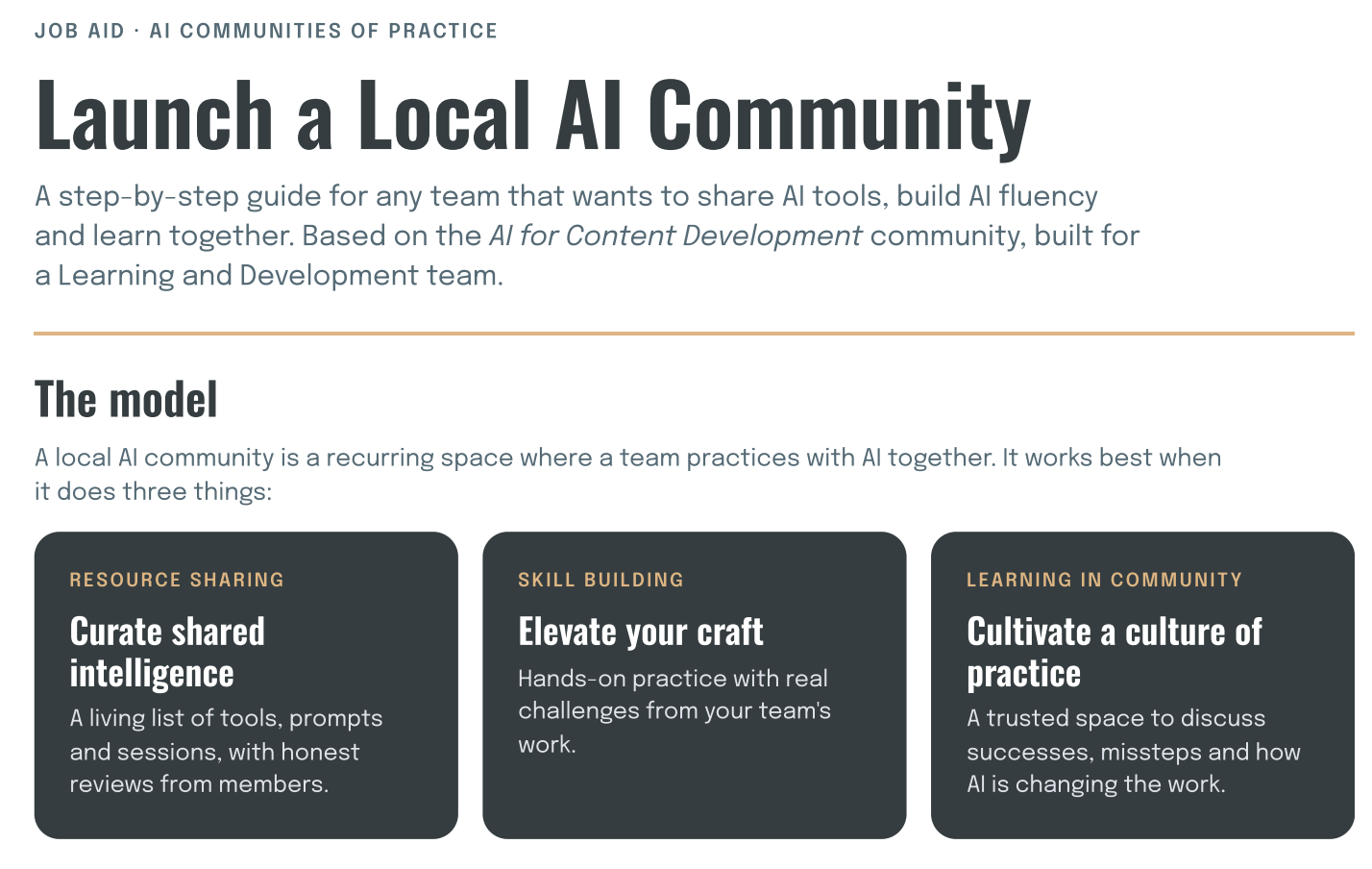
Summary: AI for Content Development is a community of practice that gives a Learning and Development team a shared structure for how it uses AI. Members curate tools and trainings, practice hands-on with real L&D challenges, and talk openly about what works and what doesn't. A step-by-step job aid now packages the model so teams at other companies can launch their own local AI communities.
Challenge: AI tools were arriving faster than the team could make sense of them. Team members were experimenting on their own, at very different levels of comfort, with no shared view of which tools to use, how to use them well, or where AI should and shouldn't play a role in their craft.
Solution: A recurring community built on three pillars: resource sharing, skill building and learning in community. A shared hub page holds recommended trainings with member reviews and a table of approved tools, and each session pairs a demo with hands-on practice and open discussion. The design draws on learning science:
Communities of practice: people who share a craft learn faster together than alone.
Deliberate practice: hands-on work with real L&D challenges builds fluency that demos alone can't.
Social learning: peer reviews and demos show what good AI use looks like in this team's work.
Psychological safety: openly sharing missteps as well as wins makes it safe to experiment.
Design process: The workshop was built using ADDIE.
Analysis: The team's AI use was individual and uneven, with no shared tools, norms or language.
Design: Three learning objectives, one per pillar, set the purpose and shaped every session.
Development: A hub page gathered recommended trainings with member reviews and a table of approved tools, tasks and access points.
Implementation: Recurring sessions combined tool demos, hands-on practice and discussion, then the model was packaged as a job aid for other teams.
Evaluation: Training completion, shared norms and how assets were being built showed whether AI use was becoming consistent.
Expected results: Every member of the content development team was trained on the team's AI tools and normed on how to use them. The team reached the point where 100% of its assets were created using a system established in this group. The job aid now gives other teams a repeatable way to build the same structure and fluency.